I didn’t learn about real rest until I was in my thirties.
I recently saw a photograph of a small peninsula in a large body of water, its connector was the narrowest of alleys. And on it stood one lone tree. As I studied the beauty of the water and the distant green horizon, I found myself drawn to the loneliness of that tree, isolated from any forest or grove.
In some way, it made me feel a longing for that same isolation. I needed to ask myself why it had such appeal, a question which sparked a journey back in time for me.
My three kids are young adults now, so the chaos of our young family is behind me. Those years swirled around us like they do for many, a flurry of school, extracurriculars, church and social activities.
And they were loud. SO. LOUD.
I needed real rest
In my mind’s eye I can envision myself aching for quiet and space and the opportunity not to be covered in spit-up and crumbs. Days would go by before I felt I even had a chance to think one coherent thought.
Many young mamas I knew talked about aching for coffee dates and girls’ nights, but I just longed to be alone. Solitude seemed elusive and how I ached for it!
Is that why the lone tree seemed so appealing?
Ironically, when I did have time to myself in those days, I still never felt the real rest I hoped for. I didn’t rest well. I hid.
Hiding, not resting
If I’m honest, there were many years where I actually resented people. I didn’t want them in my space, whether they needed my help or wanted to help me. I felt as though I grew layers of prickly exterior as a shield, not the most attractive outfit for the wife of a pastor.
In hindsight, I believe my resentment grew from fear. I was afraid of vulnerability because I believed the lie that people would reject me if they knew who I really was. My hard shell was a self-protective casing to keep people from seeing and knowing me.
I have seen the God who sees me
But I have now seen the God who sees me. He was patient, and He continued to reveal Himself as the generous and kind Father He is. He was showing me the value of connection, reminding me it is His character and mine to be in community.
Ironically, He often showed me Himself through the very people I sometimes didn’t even want in my space. They were generous, joyful. They were gracious and patient and real. They knew the value of slow conversations and real rests.
Through their friendship my longing for connection started to grow – I no longer dreaded companionship, I welcomed it. I no longer hid myself, but I shared parts of myself and I started to grow.
Real rest
I still need quiet in order to recharge. I’m an extroverted introvert. But that need for quiet is no longer tinged with the desire to escape from everyone. It is respite, not resentment. It is real rest I want. And therefore, the quiet is much more refreshing, and it allows me to re-enter community with joy.
Not isolation…real rest
When I look at that lone tree, I think that’s what I see now. It’s the quiet, real rest, not the isolation. It’s the preparation for joy-giving, not the retreat from people.
When God says He is making all things new, He means it.
“Good genes are nice, but joy is better.” Or so said the byline of the Harvard Gazette article I ran across recently. I was intrigued for obvious reasons, but not surprised by what I read. Because I have been contemplating that very thing: does our longevity depend at least in part on the quality of our relationships?
I have observed that the most fulfilled people I know seem to be the ones who are happy in their family and friendships. The people who seem most able to handle the tensions and tragedies of life are the ones who are well-rooted in relationships. More than financial security, job happiness, and even physical health, it seems to me that thriving relationships contribute to joy and longevity.
Is it true that a long joyful life depends on our relationships?
Have you ever been surprised by the resiliency of someone facing the unimaginable? I have. And when I think back, those people who have surprised me are ones who have deep family and friend relationships.
So it probably shouldn’t surprise us that there is such a significant battle raging against healthy relationships. If people will know we are Christians by the way we love one another (John 13:35), you better believe there is a very real spiritual battle trying to undo it all.
Relationships under fire
Families are fractured, friendships and marriages are compromised by competition, division of pride and deceit, and innocence is stolen by the very people that should care and protect. A war is waged on joyful, healthy relationships.
Further, social media (as helpful as it is for some things) has convinced us that superficial relationships are real and deep and enough. When we also considered the trending rise in anxiety, isolation, depression and suicide that seems to correlate with the increasing use and prevalence of “social” media, the conclusions of the Harvard Gazette are reinforced.
“When we gathered together everything we knew about them about at age 50, it wasn’t their middle-age cholesterol levels that predicted how they were going to grow old,” said Waldinger in a popular TED Talk. “It was how satisfied they were in their relationships. The people who were the most satisfied in their relationships at age 50 were the healthiest at age 80.”
The Harvard Gazette
What can we do?
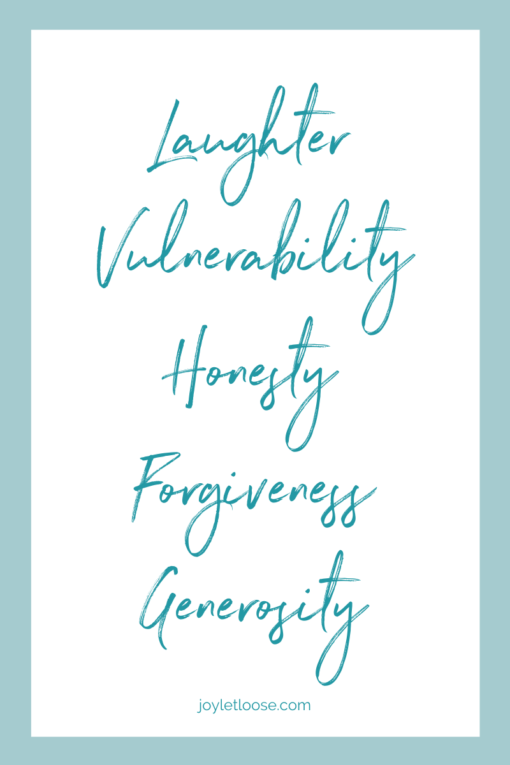
Well friend, I’m glad you asked. If we want to improve our longevity, we can care for our physical, emotional, and spiritual health. And this needs to include working on our relationships. Here are just a few important components to healthy, thriving relationships.
Laughter
Do you remember that saying…couples that play together stay together? I think this extends beyond marriages too. Life-giving laughter and relaxed enjoyment are important in any relationship in order for it to thrive. We build trust there. We create memories. Surges of endorphins help us associate positively with those particular companions, and the sense of well-being they create are incidentally also good for our hearts. We want to be around the people who make us belly laugh – it’s good for our health.
Allow for many moments of laughter, and be someone who brings a smile to others and gives permission to stop and enjoy light moments.
Vulnerability
But we also need the people who help us cry it out. The ones who don’t give up on us when we bare the ugly parts we are working through. Trust and intimacy only grow as we open ourselves up to be known, and we become the safe place for another to do the same.
Don’t allow fear to stop you from increasing in vulnerability within your relationships. Show people who you are, and love them for doing the same. Healing happens in vulnerability, so any fractures in our relationships require it if we are going to become healthier.
Honesty
We simply must speak the truth in love. Deep, fulfilling relationships are able to withstand the hard conversations. Cultivate an environment where there is openness to correction, room for difficult discussions, allowance for differing opinions, and the collective pursuit of wholeness.
We must be able to receive it just as much as we dish it out, so pray that the Lord will help you increase in your humility to be transformed through conversation and prayer. Ask Him to help you season your conversations with grace as you pursue growth together.
Forgiveness
Nothing destroys a relationship quite like a grudge. Unforgiveness is often a silent enemy wreaking havoc on our minds, bodies, and connections. When we harbor resentment, it compromises our ability to trust others, it comes against our physical health, and it robs us of joy. Holding on to it cripples us even more than it impacts the person who hurt us.
If you are in a relationship that puts you in physical or emotional danger, please reach out for help. You do not need to stay there because you hope it will change. If you have been able to come out of a relationship that caused you harm, please seek the help of a Counsellor and a Pastor. Find someone who can help you walk through your healing process in a healthy way.
Whenever possible, apologize. Relationships grow stronger when you are humble enough to admit you are wrong, and you care enough for the other person to make it right. And whenever you can, release yourself from the trap of unforgiveness.
Generosity
Thriving friendships are selfless, giving, grace-filled, and generous. They consider the well-being of the other first, lifting up and not tearing down. They don’t keep a record of what was given and received. We offer without expecting anything in return. They find joy in serving the other.
Healthy relationships also discover how two people complement each other; How one’s strengths help another’s weaknesses, and how they are in fact stronger together. They delight in being a united and generous force together and find ways to impact the world with their collective skills and gifts. They give of themselves and find joy.
A long, joyful life
“…the key to healthy aging is relationships, relationships, relationships.”
George Vaillant
I am a champion of people’s wellness because God has called me to let JOY loose in the lives of people around me. It’s my joy to come alongside people and find health in their bodies, minds, emotions, and spirits. I have become convinced that as believers in Christ we can radiate the life and joy of Jesus through our relationships, bringing life wherever we go.
And as we are intentional to foster and deepen our emotional and relational wellness, we will further our longevity and increase our opportunities to show this world His love.